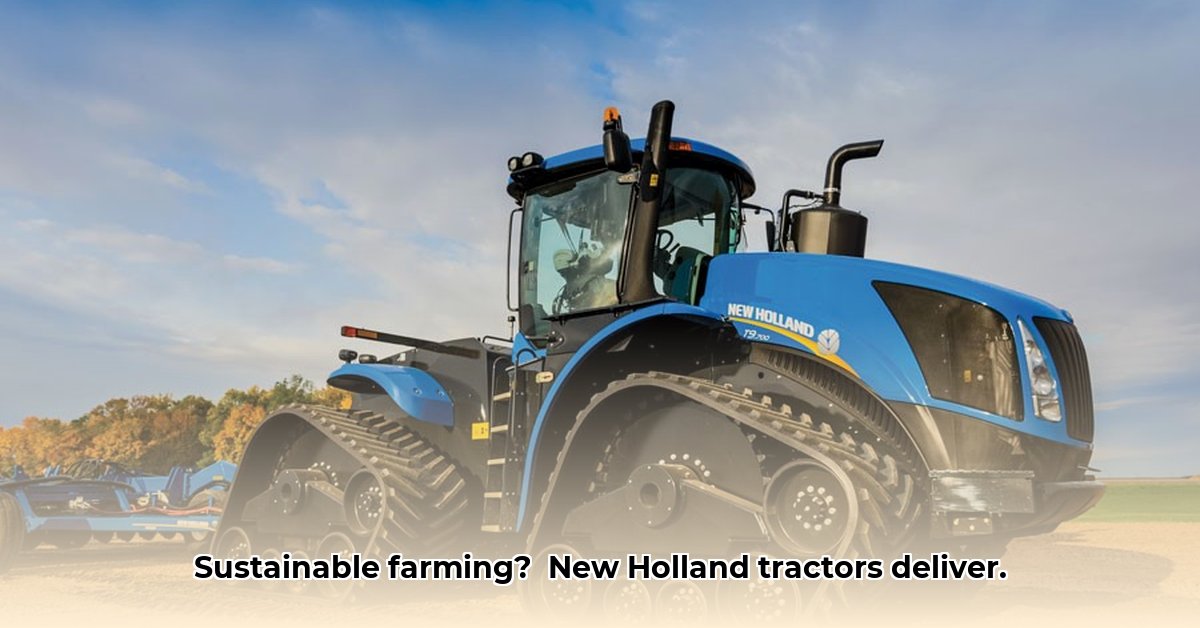
New Holland T9 Tractors: A Deep Dive into Sustainable Farming
The New Holland T9 series represents a significant advancement in agricultural technology, promising enhanced sustainability through fuel efficiency and precision farming capabilities. For more information on compatible attachments, visit New Holland Attachments. This analysis delves into the technological features, sustainability implications, market positioning, and actionable insights for various stakeholders interested in integrating this technology into their operations.
Technological Features and Specifications
The New Holland T9 tractors boast impressive horsepower, but their true innovation lies in enhanced fuel efficiency and integrated precision technology. New Holland claims a 2% fuel consumption reduction compared to previous models – a seemingly small figure, but significant over an entire farming season. Further cost savings are realized through extended service intervals, now ranging from 1200 to 1800 hours, minimizing downtime and repair expenses. The IntelliView™ 12 display and Sidewinder™ Ultra armrest provide intuitive access to advanced data management tools, enabling precision control over planting, fertilizing, and harvesting.
Sustainability Assessment: Quantifying the Environmental Impact
While the fuel efficiency improvements are demonstrable, comprehensive data on greenhouse gas emission reductions resulting from the T9's precision farming capabilities is still needed. Similarly, rigorous field studies are required to accurately quantify the savings in water and fertilizer usage. The potential for such savings is significant, given the tractor's precise application technologies; however, more robust data is vital for a complete sustainability assessment. This lack of readily available data, however, does not negate the potential environmental benefits; these are simply areas ripe for further research and independent verification.
Market Analysis: Cost, Competition, and Barriers to Adoption
The high initial cost of the New Holland T9 series presents a major barrier to entry for smaller farms and those with limited budgets. Leasing options can mitigate the upfront investment, but a thorough cost-benefit analysis, considering the tractor's lifespan, is crucial. The reliance on New Holland's proprietary technology might also limit compatibility with other farm management systems, potentially creating vendor lock-in. Farmers should therefore compare the T9 against competitors such as John Deere and Case IH to make an informed purchasing decision.
Actionable Insights for Stakeholders
The following actionable steps are recommended for various stakeholders interested in incorporating New Holland T9 tractors into their operations.
Large Farms/Corporations: Conduct thorough ROI analyses, initiate pilot programs to evaluate performance, and explore diverse financing mechanisms for efficient adoption. Complete system integration with existing farm management software is recommended for maximizing data utilization and long-term efficiency gains.
Small/Medium Farms: Carefully assess affordability; leasing may be a viable option. Prioritize features offering the greatest return on investment, focusing on those that immediately address critical operation needs. Gradual adoption, starting with features providing the highest impact, is advised.
New Holland: Invest in comprehensive field testing to generate verifiable data on fuel efficiency, emissions reduction, and resource conservation. Develop robust user training programs to maximize the effectiveness and understanding of integrated technologies. Continued investment in research and development, exploring interoperability and alternative fuels (such as biomethane) are key for long-term competitiveness.
Government Agencies: Develop targeted subsidy programs to encourage the adoption of advanced farming technologies, concentrating on supporting small- and medium-sized farms. Incentives designed to promote the use of precision farming techniques, data-driven decision-making, and sustainable resource management practices should be prioritized.
Conclusion: The Future of Sustainable Agriculture
The New Holland T9 four-wheel-drive tractor offers a substantial advancement in agricultural technology. Its potential to enhance both farm efficiency and environmental sustainability is undeniable. However, the high purchase price remains a significant obstacle. A thorough cost-benefit analysis, taking into account the long-term operational costs, potential revenue increases due to increased efficiency, and the potential environmental benefits, is critical for all stakeholders. Continued research into alternative fuels and autonomous capabilities will further shape the future of sustainable agricultural practices. The responsible integration of such advanced technologies is key to achieving a future of both economic prosperity and environmental stewardship in farming.